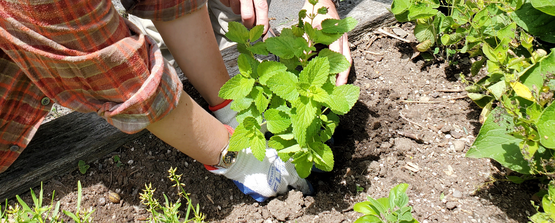
A Master Gardener volunteer tests soil pH.
Soil Testing Services
Why Test Soil?
A soil test will tell you what nutrients are in your soil and what you may need to add (in the form of fertilizer) for successful crop growth. Plants need nitrogen, phosphorous and potassium (macronutrients) as will as micronutrients to grow. Deficiency or excess of these elements will impact the health and productivity of plants. In addition, the pH (acid/alkaline level) of your soil has an impact upon how much of your soil's nutrients your plants will be able to use. CCE-Essex's Agriculture and Horticulture Programs can provide or arrange several different tests for your soil, and can help you to interpret the results and choose an appropriate course of action if necessary.
pH Testing
A pH test measures the acid/alkaline level of your soil. In the pH scale, 7.0 is considered neutral; lower numbers indicate acid soil, while higher numbers indicate that the soil is alkaline. Most plants prefer a pH of 6.8. pH levels influence nutrient availability, with most nutrients being available to plants when the pH is in this range (6.8-7.0). If a soil is too alkaline or too acid, certain nutrients may be limited. To change soil pH to the desirable range, you will either add lime if the soil is too acid or sulfur if the soil is too alkaline. With your pH test result, we will let you know what amount of lime or sulfur is needed if any.
The CCE-Essex Horticulture Program will perform a pH test on soil samples that are brought to our office for a fee of $2 for up to 3 samples. Please see instructions on "How to take a soil sample", and print and complete a home garden soil test form. If you are unable to download or print the form in advance, hard copies are available at our office.
We also sell Cornell pH Test Kits. When properly used, the pH can be determined to approximately +0.1 pH unit. This is adequate for most situations. Note: the pH kit cannot be used accurately by a color blind person. Please contact us for current prices.
Nutrient Analysis
Soil samples for nutrient analysis are sent by the client to the Dairy One Soils Laboratory in Ithaca. Copies of the test results are returned to the individual and to CCE-Essex about one to two weeks later, and you may contact us, if necessary, for assistance in interpreting your results.
Dairy-One Soils Laboratory (800) 344-2697 or visit their website
Standard soil nutrient test:
This test provides recommendations for establishment and maintenance of home lawns and gardens, commercial turf, commercial vegetables, commercial fruit, and field crops (pasture, hay, annual crops). Measures pH (in water), phosphorous, potassium, calcium, magnesium and micro nutrients including organic matter. Samples are sent to Dairy-One Lab located at 730 Warren Rd., Ithaca. Expect at least one week for test results to be returned.
Download and print the correct forms to include with your soil test samples. (NOTE: when you visit the above link, you will see a list of different forms. For testing home garden soils, download and print Submittal Form H for Lawn, Garden and Landscapes.
Last updated December 11, 2025
-
Master Gardener Volunteer Meeting
Friday, August 7
10:00 AM - 12:00 PM -
Master Gardener Volunteer Meeting
Friday, September 11
10:00 AM - 12:00 PM -
Master Gardener Volunteer Meeting
Friday, October 9
10:00 AM - 12:00 PM